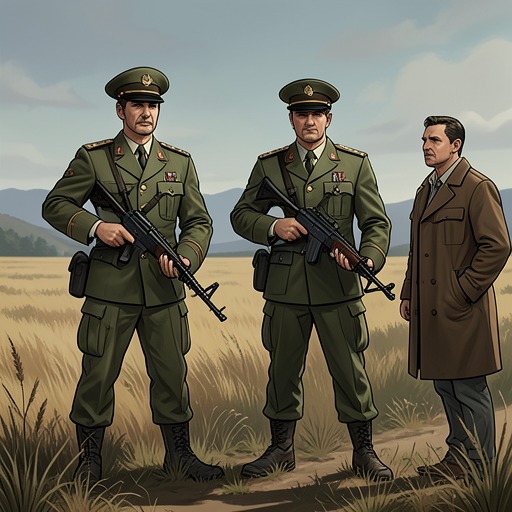
The killing of three Iraqi prisoners at Crows' Hill
Down Cemetery RoadThe killing of three Iraqi prisoners at Crows' Hill was a concealed wartime execution that followed Michael Downey and Tommy Singleton beyond the Gulf War and into the machinery of official secrecy. The men were not punished openly: the account of the killings instead leads into the concealment of the incident and the authorities’ later efforts to contain the soldiers themselves.
Background and Circumstances
Near the end of the Gulf War, Downey and his friend Tommy Singleton served for three months as guards at Crows' Hill, a camp for Iraqi prisoners. Among the prisoners was a group captured at an Iraqi military compound where a torture chamber had been discovered. Its equipment included electric batons and chains attached to the ceiling; a bathtub was streaked with blood, but no bodies were found. Some people treated the absence of bodies as irrelevant, reasoning that the victims had been buried. The narrative does not establish what had happened to them. Against this unsettled background, the later killing of three prisoners would itself become another violence obscured by an official account.
The Killings and Their Concealment
In Amos Crane’s account, one dark night Downey, Tommy Singleton, and several other soldiers took three Iraqi prisoners out to the wire and shot them dead. Crane speculates that the men may have been drunk or high, but admits that he neither knew nor cared; the uncertainty around their state of mind does not soften the concrete fact of the execution. The prisoners had been among a group captured at the compound where the torture chamber was found, but the narrative does not establish that these three had committed any crime or posed a threat. Their killing is presented as an act carried out by the guards, not as a recorded sentence or an authorized battlefield engagement. The soldiers could have faced execution themselves. Instead, because the Gulf War was popular and officials did not want to spoil its public image, the authorities arranged a cover-up. Downey, Singleton, and the others were removed from Crows' Hill and kept in close confinement for the rest of the war. The concealment thus extended beyond hiding the deaths: it also meant containing the soldiers who had carried them out. After the war, the army still did not know what to do with the group. They remained a scandal waiting to happen until they were recruited en masse for special services, a move that gave the institution a way to use them while keeping the incident out of public view. Crane’s account makes the killing part of a larger pattern in which political convenience replaces open accountability, and the men implicated in violence are first confined, then repurposed.
The Incident’s Afterlife
After the war, the soldiers were folded into special services and then handed over to The Department as men officially declared dead. That erasure joined the Crows' Hill cover-up to a further secret: The Department kept the survivors at The Farm to observe the effects of a nerve bomb used in a desert experiment. The experiment had failed to immunize everyone; its reported success rate was only seventy per cent, and officials expected the men’s cancers to develop before they were discarded. The soldiers’ earlier confinement had therefore become part of a longer chain of institutional use, concealment, and anticipated death.
The killings also return as an accusation in the later confrontation between Howard and Sarah Trafford. Howard invokes Downey’s shooting of unarmed prisoners to cast him as a war criminal, while Sarah points to the government’s use of him as a guinea pig. The exchange does not undo the prisoners’ deaths or absolve Downey; it places his crime beside the state’s own concealed violence. Crows' Hill thus remains more than a buried wartime episode: it is a fact that can be used against Downey, even as the institutions invoking it have hidden their own responsibility for what happened to him.
The Killing as a Later Accusation
Years later, Howard invokes Downey’s shooting of unarmed prisoners to persuade Sarah Trafford that Downey is dangerous and morally compromised. Sarah does not answer the charge directly; instead, she confronts Howard with the Department’s own conduct, saying Downey was used as a guinea pig. Howard replies that Downey volunteered. The exchange leaves both the prisoners’ deaths and the desert experiment in view, but places them inside competing claims about responsibility: Downey’s past violence is presented as evidence against him, while the institution’s treatment of him is defended as a choice he made.
Howard also concedes that his side wanted to make contact with Downey and bring him back into the fold, but says they did not expect him to go haywire. That explanation shifts attention from the original execution to the later consequences of institutional control without erasing the crime. Crows' Hill remains a fact Howard can wield against Downey, even as the dispute exposes how readily official responsibility is narrowed to an individual’s actions.